

Chinese: Many languages in one – why the right variety matters
With over a billion speakers, Chinese is one of the world’s most important languages – and one of the most complex. The term “Chinese” covers a large number of language varieties, some of which differ significantly in terms of pronunciation, vocabulary, grammar, and writing. This diversity is a decisive factor for professional translations.
Mandarin is China’s official language with around 995 million speakers and has a prominent status throughout mainland China as well as in Taiwan, Hong Kong, Macao, and Singapore. This is particularly evident in writing. However, there are also several widespread dialects or language groups, such as Cantonese, Wu, and Min. Some of these – such as Cantonese, which is mainly spoken in Hong Kong and southern China – differ so much from Mandarin that they are considered independent languages.
Regional differences, such as in Taiwan, and the use of simplified or traditional characters also play a central role.
To provide an overview of these relationships, we have developed a diagram together with our Chinese language experts. It shows the most important Chinese varieties in a geographical context and distinguishes between spoken and written language.*
Precisely this differentiation forms the basis of our work. When translating into Chinese, we work with our clients to define the key parameters: target region, variety, and written form. In this way, we ensure that your text is linguistically precise, culturally appropriate, and effective for your audience.
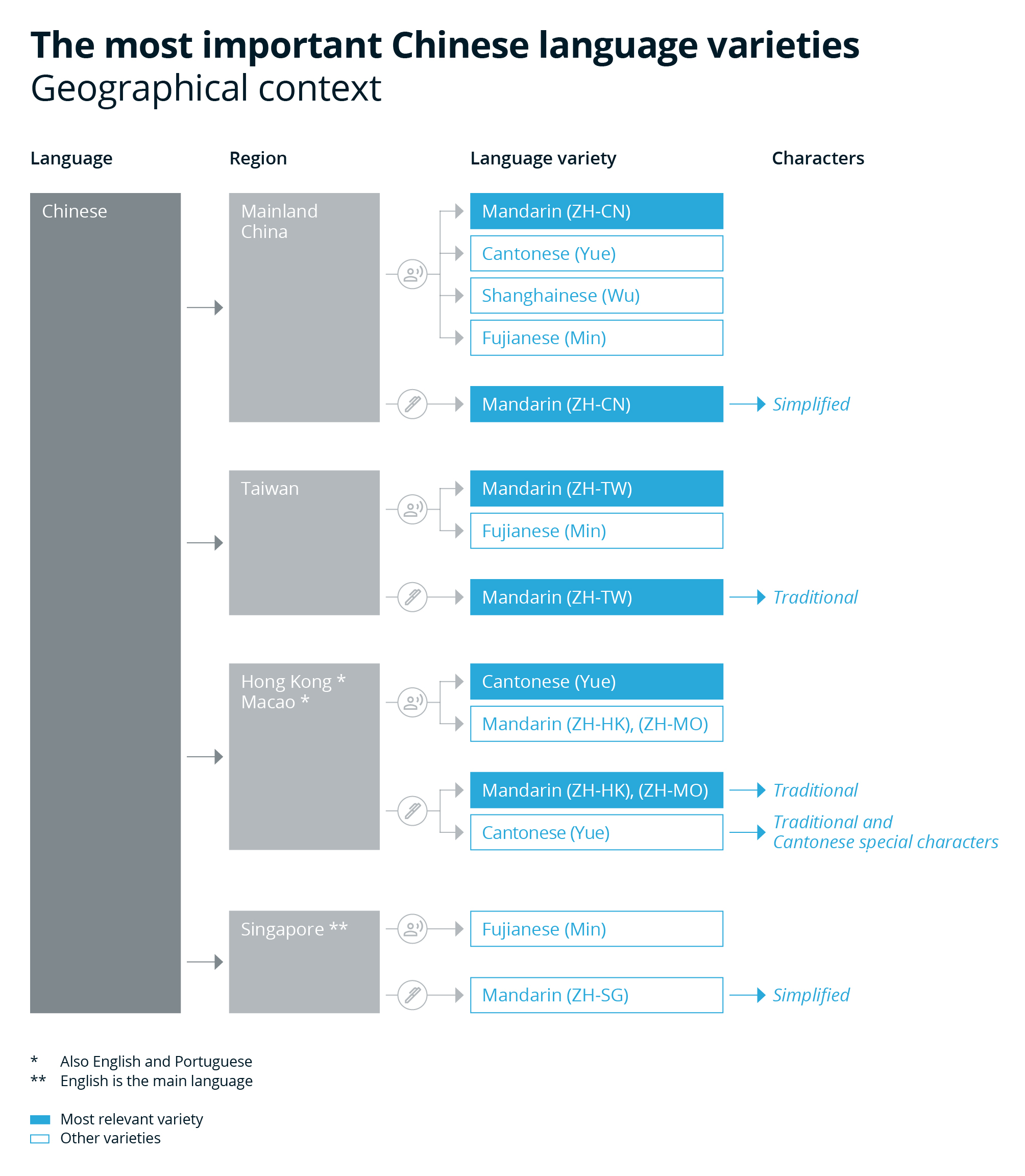
* The list only includes the five largest regions where Chinese is spoken and written as well as the four language varieties with the most speakers: Mandarin (approx. 955 million), Cantonese Yue (approx. 85 million), Shanghainese Wu (approx. 80 million), Fujianese Min (approx. 75 million). There are more language regions, e.g., in Southeast Asia. If available, language codes
are listed in accordance with ISO 639 beside the language variety.


About Post Author
